What Makes a Container Difficult to Convey?
You can usually spot the obvious ones.
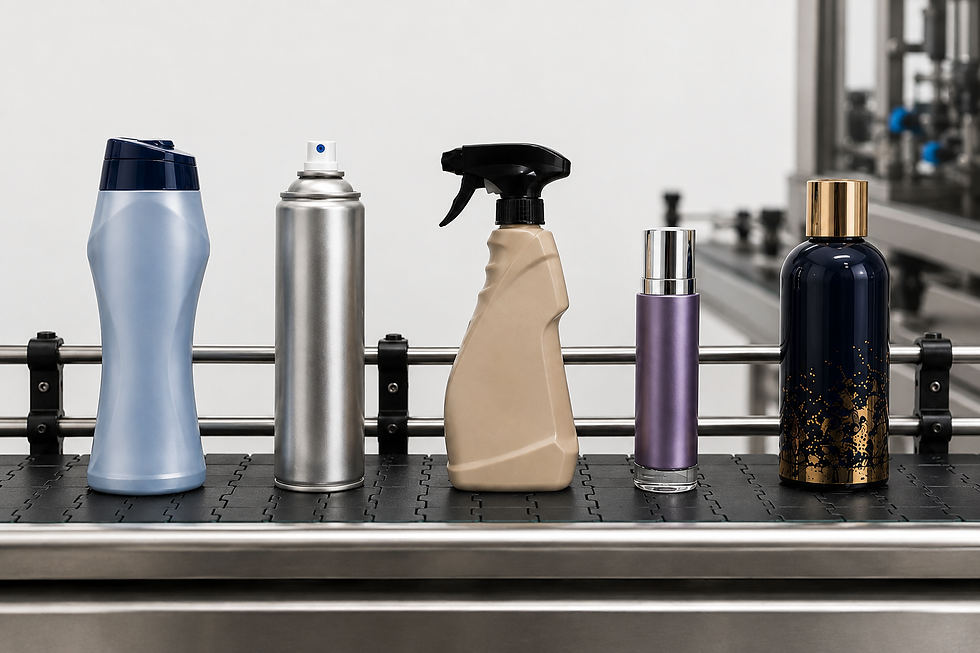
The tall bottle with a narrow base. The package with an offset neck. The highly sculpted container that looks great on a store shelf but wasn't exactly designed with conveyor guide rails in mind.
But some of the most challenging containers don't look particularly challenging at all.
What makes a product difficult to convey often has less to do with its appearance and more to do with what needs to happen as it moves through production. A container may need to remain oriented for labeling, arrive in exactly the right position for filling, travel through an inspection process, or reach the end of the line without a highly decorated surface getting scuffed along the way.
In other words, conveying isn't simply about getting a container from one end of the line to the other.
It's about getting it there the right way.
Start With Stability
Shape is still a good place to start.
Tall containers, narrow bases and high centers of gravity can all make a product more susceptible to tipping. An asymmetrical package adds another variable: it may rotate, shift or make inconsistent contact with guide rails as it moves.
These issues tend to become more noticeable when a container accelerates, stops, changes direction or transfers between pieces of equipment.
And today's packaging doesn't always make the job easier. Brands understandably want containers that stand out, which can mean tapered profiles, offset necks, handles, curves and other distinctive features.
Those features can be great for the consumer and considerably less convenient for the conveyor.
A custom puck effectively gives that unusual product a new exterior for the production line to handle. The inside can be designed around the specific container, while the outside provides the consistent footprint and geometry the conveyor wants.
That's a relatively simple idea, but it can solve a surprisingly wide range of handling problems.
Sometimes the Container Isn't the Difficult Part
Consider an aerosol can.
It's cylindrical. It has a flat footprint. At first glance, there isn't much about it that screams "difficult to convey."
But filling the container isn't necessarily the end of the process.
Pressurized aerosol products may need to pass through in-line leak detection before continuing downstream. That introduces another requirement: the container has to move reliably through the testing process as well as the conveyor itself.
Filled cans are transported into the water bath, submerged for leak detection and then transitioned back into the production process.
It's a useful example because the challenge isn't immediately apparent from looking at the package.
The same issue exists with other types of inspection. A more recent Packaging World example looks at leak testing for tall, narrow, oval and reverse-tapered containers, where maintaining control and alignment becomes part of successfully performing the test.
That's an important distinction when thinking about container handling.
The question isn't just, "Can we convey this?" It's, "What does this product need to do while we're conveying it?"
A Small Footprint Can Become a Big Problem
Some conveying challenges really do come down to simple physics.
A small-diameter container gives the conveyor less to work with. Add height, a tapered bottom or an unusual center of gravity and maintaining stability becomes increasingly difficult.
At low speeds and in a straight line, that might not present much of a problem. Production lines aren't always that forgiving.
Containers encounter transfers. They stop and start. They move through curves and between different pieces of equipment. Line speeds change.
A puck can increase the effective footprint of the product and give the surrounding equipment a larger, more predictable surface to handle.
That consistency becomes especially valuable when several different products need to run on the same equipment.
Different Products. A Consistent Line.
This is where pucks become particularly useful for manufacturers managing multiple package formats.
The product inside can change considerably without requiring the exterior dimensions presented to the conveyor to change with it. While the internal features of the pucks accommodated different containers, the outside dimensions remained consistent. The system also presented the container necks at a common height to downstream machinery.
Bottle fillers that deploy this common footprint strategy typically see a 25% increase in line speed and a two-thirds reduction in changeover time.
Package designs change. SKUs multiply. Marketing teams introduce new shapes and sizes. Production equipment still needs repeatability.
A puck can provide the interface between the two.
Sometimes the Challenge Is Protecting the Package
There's another consideration that has nothing to do with tipping.
The product has to look good when it reaches the customer.
Glossy bottles, foils, decorated surfaces and other premium finishes can be sensitive to repeated contact with guide rails and surrounding equipment. A package can make it through production perfectly upright and still arrive at the end of the line with marks you don't want on the shelf.
In those applications, the puck isn't simply providing stability. It can help determine where contact occurs as the product moves through the line, keeping guides and other equipment away from more sensitive areas of the finished package.
That's an easy part of conveying to overlook.
For the customer picking up the product, however, it's anything but.
The Container Is Only Half the Story
There isn't a checklist that defines a difficult-to-convey container.
A tall bottle might run perfectly well in one application and create problems in another. An aerosol can might look simple until an in-line testing requirement changes how it needs to be handled. A beautiful new package design might introduce an orientation, stability or surface-protection issue that didn't exist with the previous container.
That's why the conversation at Advantage Puck starts with more than dimensions.
We want to know what you're making, but we also want to know what happens to it.
Where does the container need support? Does orientation matter? What equipment will interact with it? Does it need to be filled, capped, labeled, inspected, tested or assembled?
Are there surfaces that need protection? What happens when it transfers to the next operation?
Those details are what turn a piece of molded plastic into a puck designed for a specific production process.
Because ultimately, the goal isn't simply to make your product fit inside a puck.
It's to make a difficult-to-convey product easier to run.
Have a container or process that's creating a challenge on your line?


Comments